I’ve had a patio instead of a proper garden for most of my growing life, so containers aren’t a compromise for me. They’re just how I garden.
Over the years I’ve tried growing almost everything in a pot. I’ve learned the hard way that some crops absolutely love it and others just sulk.
Some crops are brilliant in pots. Others are a waste of space and compost.
This isn’t a ranked list of the “best” options. It’s more like what I’d tell a friend who’s just moved into a flat with a south-facing balcony and wants to grow something to eat.
What’s worth the space, what pot size it actually needs, and what’s probably not worth the bother.
You don’t need beds or a lawn.
You just need the right crops in the right pots.
The crops I’d plant first
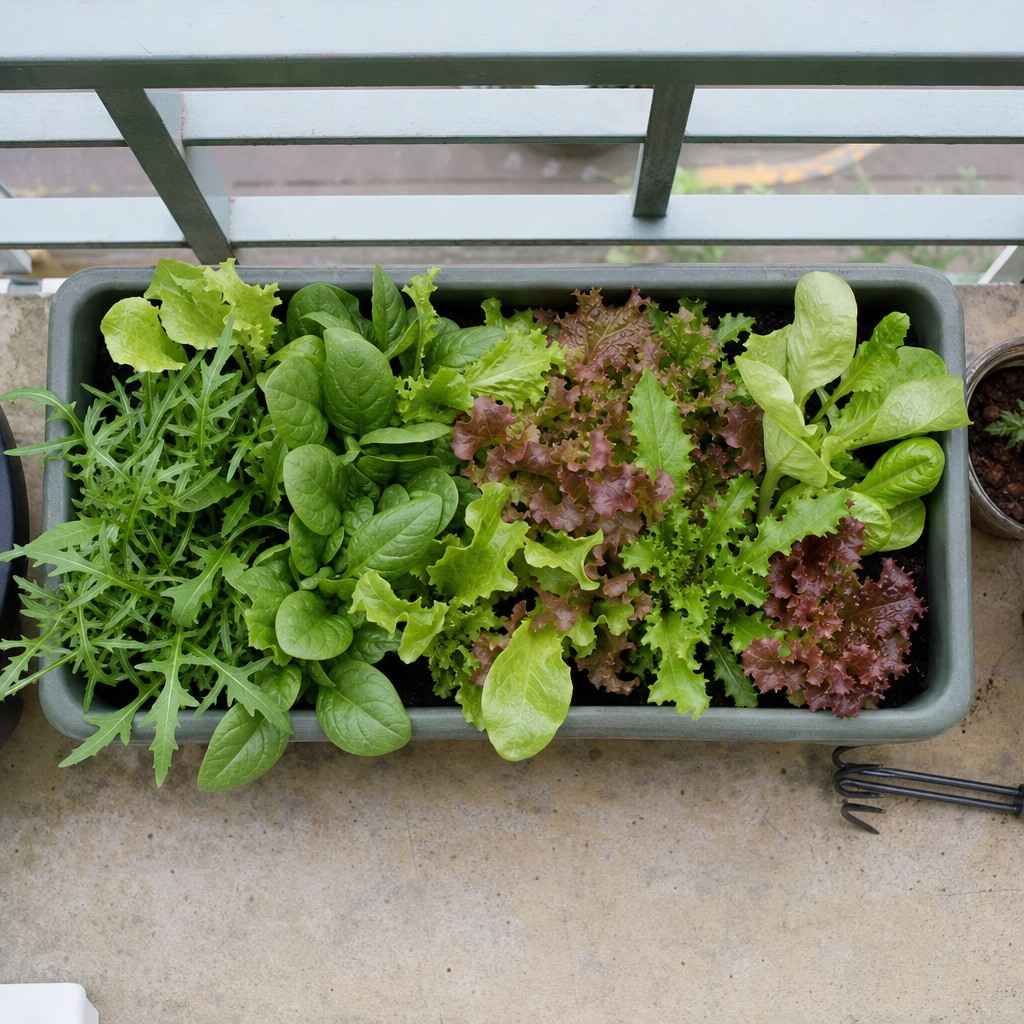
These four are the most forgiving and the most satisfying. They crop fast, recover from beginner mistakes, and don’t need enormous pots.
Salad leaves are probably the best place to start. Cut-and-come-again varieties like rocket, spinach, and loose-leaf lettuce grow fast, don’t mind a bit of shade, and give you something to harvest within a few weeks of sowing.
A wide, shallow container works better than a deep one. Their roots aren’t long, so you’re not wasting compost. I use a window box and sow a new row every three or four weeks to keep it going through the season.
Radishes are almost embarrassingly easy. Sow them in a container of any reasonable depth, thin them out a little, and you’ll be pulling them six weeks later.
They’re good for filling gaps between other crops too, since they’re done before most things have really got going.
Six weeks from sow to pull. Hard to beat.
Herbs live on my kitchen windowsill for half the year and outside the rest of it. Mint, chives, parsley, and coriander all do well in pots.
Just keep mint in its own container. It will muscle out everything else if you let it share. Basil needs warmth and as much light as you can give it, which is why I usually start basil seeds indoors a few weeks before I move it outside.
Cherry tomatoes are the classic balcony crop, and for good reason. They genuinely do better in pots than in beds in a lot of UK summers because you can move them against a warm wall.
Use the biggest pot you can manage. I’d say 30 to 40 litres at minimum. Stake them early.
Bigger pot, better harvest. It really is that simple.
Bush varieties like Tumbling Tom trail nicely over the edge of a pot and need less tying in. Helpful if you’re short on time or space.
What needs a bigger pot than you’d think
Some crops are absolutely possible in containers, but they’ll struggle in anything undersized. I’ve made this mistake a few times.
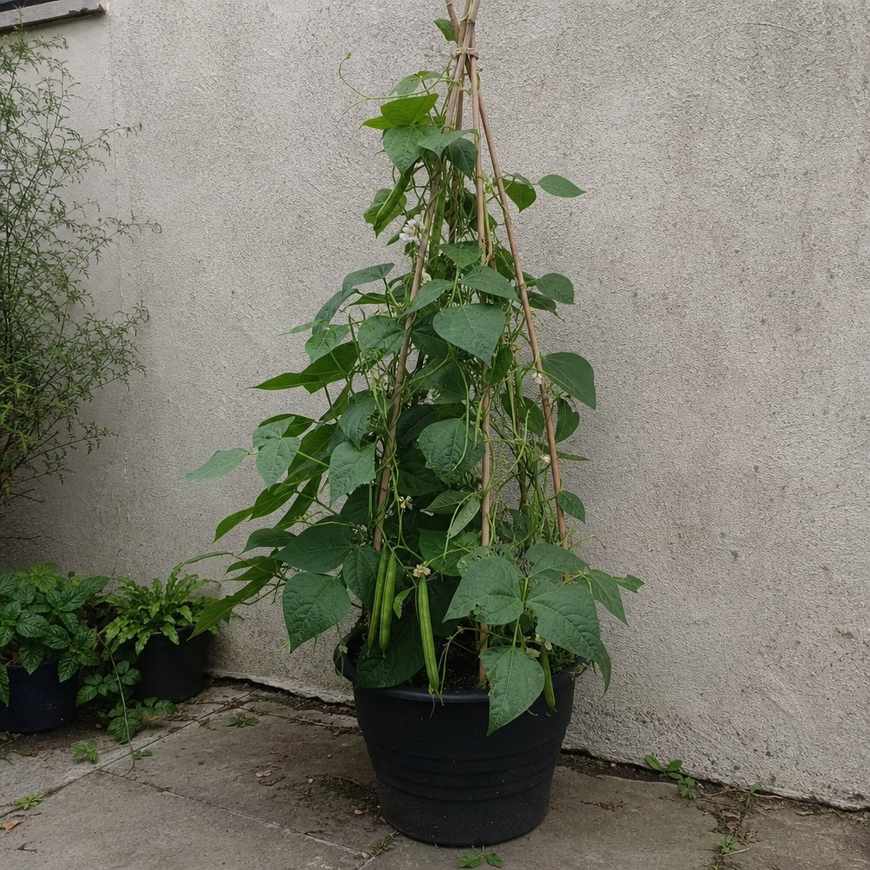
Runner beans and French beans are brilliant vertical growers and can go in a large pot against a cane wigwam, but they need something in the 40-litre range to do well.
I’ve tried them in a standard bucket-sized pot and they crop reluctantly. Give them decent depth and they’ll reward you with more beans than you need through summer.
Courgettes are a surprisingly good container crop if you’re willing to give them a really big pot. I’m talking 50 litres or a large half-barrel.
One plant per pot. Fed every week or so once they’re growing. They’ll produce reliably.
The main thing to know: they need watering every single day in warm weather. Containers dry out faster than you’d think.
Go on holiday for a week without sorting out watering, and you’ll come back to a crispy plant and a courgette the size of a marrow.
Daily watering is not optional with courgettes.
Potatoes in a bag or large pot are a genuinely fun and productive thing to grow, especially if you’ve never seen a potato plant in flower before.
Use a proper potato growing bag or a 40 to 50 litre pot, and earth up the stems as they grow. I prefer second early varieties because they fit the container season better and you’re not waiting as long for the harvest.
Lifting the bag at the end and tipping out a pile of new potatoes is oddly satisfying.
Worth it every time.
If you’re new to all of this and wondering how to set up your outdoor space for growing, it’s worth sorting out your containers and positions before you buy any plants or seeds.
What I’ve given up on in pots
I’d rather tell you what worked and what flopped in my own pots than pretend everything thrives.
Not everything belongs in a container.
Maincrop carrots are near the top of my “not worth it” list. You can grow them in containers, but you need real depth, at least 30 to 40cm, and the yield per pot of compost is pretty poor.
I’ve grown Paris Market carrots in a deep pot. They were edible but not exactly impressive. If you’re short on pots, use the space for something that earns it better.
Carrots look good in theory. In practice, not worth the bother.
Sweetcorn is another one I’d steer you away from. You need several plants to pollinate each other, which means several large pots, and the yield even in a good summer is modest.
A lot of pot and compost for not a lot of return.
I won’t bother again.
Cabbages and cauliflowers are possible but they take up a lot of space for a long time, attract every cabbage white butterfly in the neighbourhood, and aren’t really what containers are for. Leave those to people with proper vegetable beds.
Soil and watering: the two things that actually matter
Use proper peat-free compost, not garden soil. This is the single biggest thing you can do to improve your pot-growing results.
Garden soil compacts in containers, drains badly, and your plants will sulk. Purpose-made peat-free compost is lighter, holds moisture better, and has the structure pot-grown roots need.
You can find bags at most garden centres, or browse peat-free compost on Amazon if you’d rather order it. Either way, don’t skip it in favour of whatever was left over from the back of the shed.
Watering is the other thing.
Pots dry out much faster than soil, especially in warm or breezy weather.
I check mine every morning in summer and water most of them daily once things are in full growth. If your pot has drainage holes (and it must, no exceptions), you can water generously without worrying too much about overwatering.
If you want to see how containers fit into a broader approach to small-space gardening, the ideas behind balcony gardening for beginners carry over directly. Most of the same principles apply whether you’re on a balcony or a ground-floor patio.
A few things I wish I’d known sooner
The biggest mistake is planning for a different garden than the one you actually have.
Start with the space and conditions you actually have, not the garden you wish you had.
It’s very easy to buy five types of seeds in March and end up with more seedlings than you have pots for, in conditions that suit some of them and not others.
- Check how much sun your space actually gets before deciding what to grow. South-facing gets you tomatoes. North-facing steers you towards salad and herbs.
- One big pot of one thing done well is better than five small pots of five things done badly.
- Label everything. I know it sounds obvious, but I’ve mixed up my tomato varieties more than once.
- Feed container-grown crops. Unlike garden soil, compost in a pot runs out of nutrients over the season. A liquid feed every week or two makes a real difference once plants are growing and flowering.
Raising plants from seed also opens up a lot more variety than you’d find in most garden centres.
It’s easier than it sounds, and the choice is far better.
I’ve written more about the basics of starting seeds if you want to go that route. And if you’re still at the “where do I even start?” stage, the choosing plants guide is a useful starting point before you buy anything.